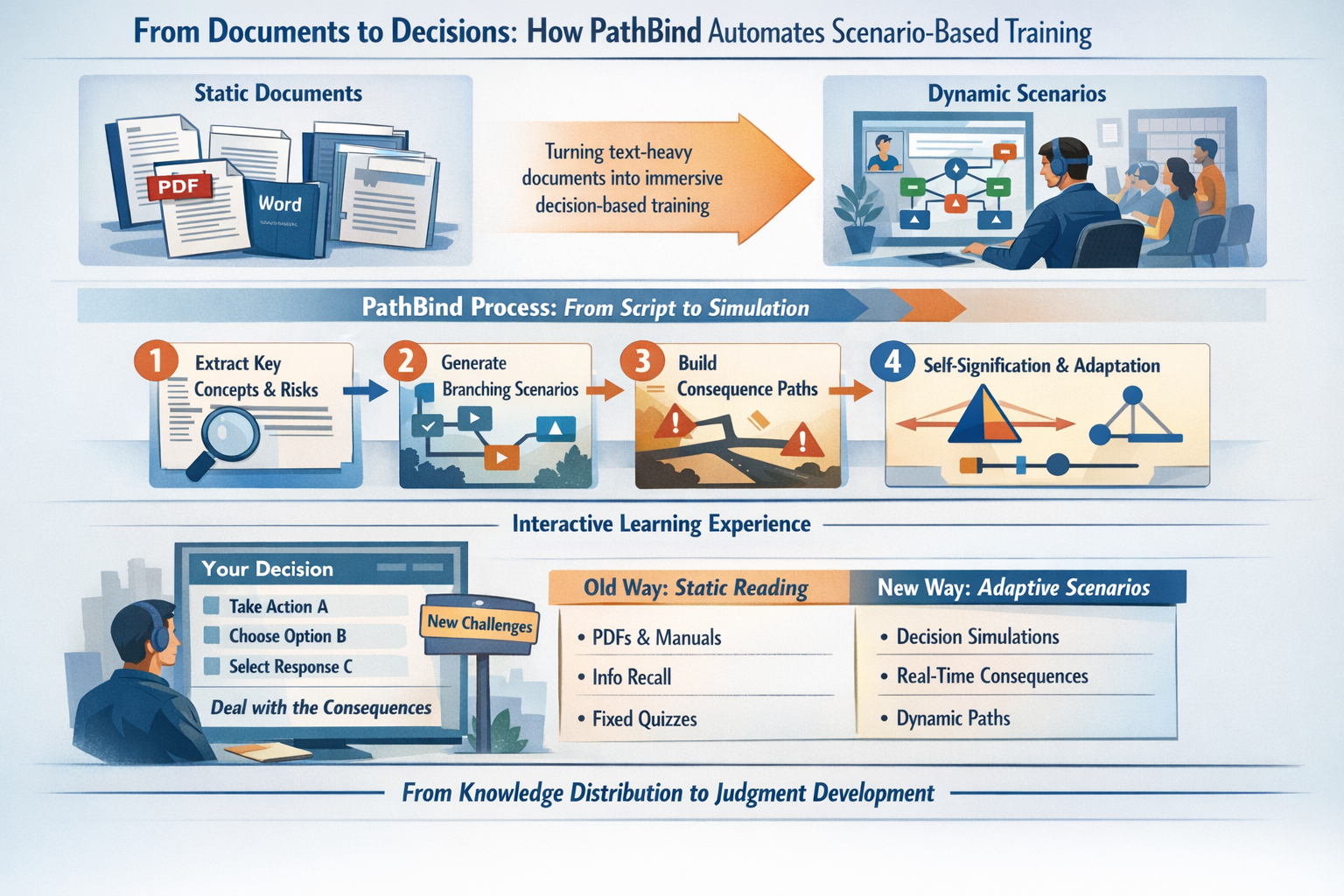
Most organizational knowledge lives in static documents.
Policies sit in PDFs. Procedures live in manuals. Critical know-how is buried in Word files and internal wikis. These materials are comprehensive, but they are not experiential. Reading them does not prepare people to make decisions under pressure.
Traditionally, converting documents into effective training requires weeks or months of instructional design work. Subject matter experts must identify key risks, write scenarios, design assessments, and manually build learning paths.
PathBind removes this bottleneck.
It automates the transition from static documents to interactive, consequence-driven training scenarios using an AI-driven process that structures knowledge into dynamic learning paths.
The problem with static training materials
Documents are designed to inform, not to train judgment.
They explain rules, procedures, and expectations, but they do not place learners inside situations where those rules must be applied. As a result, organizations face a familiar gap. Employees can quote policy language but struggle to act correctly when conditions change.
Traditional e-learning attempts to bridge this gap by adding quizzes and slides. This approach still treats knowledge as something to be recalled rather than something to be navigated.
PathBind approaches the problem differently. Instead of layering quizzes on top of documents, it transforms documents into decision environments.
How PathBind converts documents into training scenarios
PathBind automates scenario creation through a structured technical pipeline. Each step is designed to preserve the substance of the original material while turning it into an interactive learning experience.
Automatic concept and risk extraction
When a user uploads a PDF, Word document, or markdown file, PathBind scans the text to identify key concepts, potential risks, and critical decision points.
This includes:
- core rules and procedures
- areas of ambiguity
- actions with downstream consequences
- situations where judgment matters
Instead of treating the document as a block of content, the system interprets it as a set of decision-relevant signals.
Generation of branching scenarios
Using the extracted material, PathBind generates realistic decision points.
Rather than presenting multiple-choice questions with fixed answers, the system builds scenarios where each option leads somewhere different. Choices are treated as actions, not test items.
A learner’s decision shapes what happens next.
This branching structure reflects how real work unfolds. Decisions change context. They create new conditions that must be managed.
Building consequence paths instead of dead ends
In traditional training, a wrong answer stops progress until the correct one is selected.
PathBind replaces this dead-end logic with consequence paths.
When a learner makes a poor choice, the system generates a new scenario that reflects the outcome of that decision. A weak cybersecurity action may trigger a simulated breach. A compliance lapse may lead to regulatory exposure. A safety oversight may escalate into an incident response.
The learner is required to navigate the consequences of their own action rather than simply correcting it.
This is where judgment is built.
Automatic reflection prompt creation
After meaningful decisions, PathBind automatically generates reflection prompts that ask learners to explain their reasoning.
These prompts are not generic. They are tied to the specific decision and its outcome. The goal is to surface why a learner acted as they did, not just what they selected.
This step reveals decision-making patterns that are invisible in outcome-only training, including confidence levels, risk perception, and value trade-offs.
Adaptive difficulty calibration through Bayesian tracking
As learners move through the scenario, PathBind continuously updates a skill model using Bayesian tracking.
The system identifies where a learner struggles and adjusts scenario difficulty accordingly. Learners who demonstrate strong judgment are challenged with more complex situations. Learners who show uncertainty or miscalibration receive targeted practice in the areas that matter most.
This adaptation happens automatically. No manual redesign is required.
Eliminating the instructional design bottleneck
One of the most significant implications of this process is who can create effective training.
Because PathBind automates concept extraction, scenario generation, consequence building, reflection prompts, and difficulty calibration, organizations no longer need specialized instructional design teams to build decision-based training.
L&D leaders, compliance officers, and safety managers can upload a document and receive a ready-made scenario structure with mapped nodes and multiple playable paths.
The result is a dramatic reduction in time and cost, without sacrificing rigor.
A useful way to think about the process
A helpful metaphor is to think of PathBind as a digital stage director.
The original document is a static script. On its own, it describes what should happen but never changes. PathBind reads that script and instantly builds a reactive stage.
Learners step onto that stage as actors. They make choices. The scenery changes in response. New situations appear based on performance, mistakes, and recovery.
The director does not stop the play when something goes wrong. The director adapts the scene.
That is what transforms documents into training.
Why this matters for modern organizations
Organizations are under pressure to train faster, prove effectiveness, and prepare people for real decisions rather than idealized ones.
Static documents cannot do this. Manual course development does not scale.
Automated, consequence-driven scenario generation closes this gap.
By turning existing materials into adaptive decision environments, PathBind allows organizations to move from knowledge distribution to judgment development in minutes rather than months.
And that shift is what makes training matter when it counts.